Wednesday, 10 October 2012

Climbing Kilimanjaro 50 years ago

Below is the second guest post from my mum. I'll definitely be thinking about her experience when I'm struggling up that hill with all my fancy modern gear!


CLIMBING Mt KILIMANJARO 50 YEARS AGO


As a 21st birthday celebration my mother suggested a trip to climb Mt Kilimanjaro which was hastily accepted – a happy co-incidence as Kili was supposed to have been given as a birthday present to the Kaiser Wilhelm II by his grandmother, Queen Victoria, in the late 1800s. The kink in the present Kenya/Tanzania border would tend to corroborate this story. At the time the British Government had been allocated what are now Kenya and Uganda for trading and development, which became known as British East Africa, while the land south of Kenya was given to Germany and was known as German East Africa. The latter was re-named Tanganyika after the First World War when it became part of British East Africa after the defeat of the German army.

The routine way to do this expedition was to join a group organised by Marangu Hotel in the southern foothills in Tanzania. The climb entailed a four day slog, using existing huts to sleep in at nights, one above the forest line and the second at the bottom of Kibo. In the typical laid-back style in East Africa we were just advised to bring “warm clothing and stout footwear”. Although the five of us lived in the Kenya Highlands at varying heights (my home at Molo was 9,000 ft above sea level) we had never needed the relevant clothing to cope with the cold at the extreme heights to which we were ascending. No problem they had said, you can hire anything you need at the hotel. In the event we all needed snow goggles, balaclavas, gloves and long walking sticks. We carried only our personal urgent needs in small rucksacks, the rest of our equipment being carried by porters who followed us up the mountain. My own clothing was typical of the group – a couple of thick jumpers, cotton trousers, a rubberised waterproof jacket and two pairs of thin socks, plus a pair of short leather boots borrowed from a boyfriend. When climbing Mt Kenya five years later I did at least own a pair of stout jodhpur boots! Such modern luxuries as thermal underwear and padded jackets were quite unheard of then.


This was to be a major safari for my mother and me, having to drive from our home in Molo, at the top of the western escarpment of the Rift Valley, via Nairobi to Marangu, a journey of over 300 miles mainly along very basic dirt roads. As we got to know each of the other climbers in our group that evening, we were suitably inspired by the tantalising view from the hotel of the tops of both Kibo and also the smaller, dormant, Mawenzi. Early next morning we set out on our first day's walk up through the indigenous forest along a very muddy track to Bismark Hut, nestling at the foot of a cliff amongst the trees at a healthy 9,000ft. The accommodation was pretty basic with two dormitories each having several bunk beds consisting of a wooden frame covered with a thin mattress, over which we laid our sleeping bags. An outside “long drop” was located nearby but there were no washing facilities other than a bucket of cold water! We were all more than ready to eat our frugal supper seated round a camp fire in front of the hut at sundown (which is short-lived and barely lasting 15 minutes at about 7.30 p.m.) and chat by the light of a couple of Deitz (paraffin) lamps until retiring to snuggle down into our bedding shortly afterwards.

The next day we continued up a narrow track onto the moorland with tantalising views of the jagged peaks of Mawenzi slowly revealing themselves out of the mist as we climbed upwards. The scenery up here was much more varied as we traversed the saddle between Mawenzi and Kibo, and finally arrived at Peter's Hut at 12,500 ft. While the porters were unloading our gear we walked a short way up to the top of the ridge behind the hut to catch our first proper sight of Kibo in all its glory. However it was not to be, as thick cloud covered the snowy top, but the sheer bulk of it was still an awesome and somewhat daunting sight.


At about 4 a.m. the following morning we were woken by our three guides, to be plied with steaming mugs of tea and chunks of bread with which to fortify ourselves for the coming assault. None of us had slept much due to the freezing temperature and uncomfortable beds, so we were not at our best. It was, of course, pitch dark, but it was essential to make an early start in order to reach the top in time to see the sunrise at 7 a.m. By torchlight our frozen bodies set out in single file across the plateau with the three native guides spaced out between us until we stopped for a much-needed breather and another mug of tea at the foot of Kibo itself. By this time we were beginning to show ominous signs of distress – extreme lassitude, splitting headaches and in my case completely numbed hands. The chief guide was most concerned, and after a vigorous hand massage and an additional pair of gloves managed to get the circulation going again. None of us suffered full-blown altitude sickness and continued on our way. 

 The following ascent was sheer torture! Ascending in a zigzag up the scree, 6-8 steps each zig/zag, was as much as we could do at a time, such was our lack of energy and breath. Here our walking sticks really came into their own to lean on when resting as much as for balance and help while climbing. Ever onwards and upwards, until, blessed relief, we reached the rim of the crater, at Gillman's Point, 19,043 ft above sea level. Sadly the flag pole marking the spot had blown over, but was still there to mark the spot. Obligatory photos were taken to keep as proof of our conquest. We had all been born and brought up in Kenya, so none of us had experienced snow first hand and were amazed by the beauty of the ice fields along the rim.

Celebrating our success with bars of chocolate, and mugs of tea (which the guides had nobly carried up in flasks) we slowly became aware of what we had achieved. None of us cared about not continuing along the rim up to what is now known as Uhuru Peak, 600 ft higher, especially as the weather was not going to improve, and were quite content to savour the moment looking down over the thick blanket of cloud below us, highlighted by the rosy glow of the sun, which covered the whole countryside, broken only by the highest peak of Mawenzi poking its head through. That in itself was magical. We all sensed the feeling of reverence with which the native tribes regarded both Mt Kilimanjaro and Mt Kenya as the ancestral homes of their gods.

But soon it was time to begin the descent. Easy, now that all we had to do was avoid losing balance as we slid down the loose scree in short bursts, aided by our trusty sticks. We even had the energy to bypass Peter's Hut and continued on down to Bismark for the night. What bliss to be warmer and relaxed – only now could we fully enjoy comparing our individual highlights and lowlights of the trip. Never again, we all said, but agreed that despite the trials and tribulations we wouldn't have missed it for worlds.

Sunday, 7 October 2012

A 1967 ascent of Mt Kenya


Here follows the first of several guest posts by Judy Maynard, my mum, who grew up in Kenya and climbed both Mt Kenya and Mt Kilimanjaro in the 1960s, with nothing like the kit and facilities we have today! This account of her ascent of Mt Kenya in 1967 was published in "Africana Magazine", an apparently now defunct magazine, although a new publication of the same name has been in existence since 2004. I leave her to tell the story of her trip!


It was one of those cold, crisp mornings with the Kenya sky unbelievably clear pale blue. A hard frost on the grass made a jewelled silver carpet as we motored up the escarpment from the floor of the Rift Valley; the first rays of the rapidly-awakening sun greeted us over the shoulder of THE mountain, 50 miles ahead. There it stood – the ultimate goal of our long-awaited journey – beckoning us onwards, its mighty peaks sharply etched against the ever-changing colour of the newly-painted sky.

Arriving at our rendezvous, the small village of Nanyuki at the foot of the mountain, we consigned the car to a week of rest at the friendly garage. With the rest of our party we squeezed into the waiting Land Rover which was to take us up to the base camp, towards which the ponies and pack animals were already making their way.


Our route lay along the main road to the north for a few miles, then a narrow rutted track branched off, leading us almost immediately up through thick forest. At times we were more than grateful for the wire tracks laid by the British Army for use in their training manoeuvres on the steeper gradients. Up and up, climbing steadily, the monotony of the endless forest being broken only by the occasional glade, or tiny stream. Colobus monkeys, clad in their long, thick, black and white pelts, barked at us as we passed, and bright green touracos with their flashing red wings flapped heavily across the track ahead.

Suddenly, without warning we emerged onto the open moorland and stopped for our first real view. It was magnificent. Three thousand feet below us the shimmering plain emerged from the base of the mountain and stretched out until it became lost in a heat haze. Above and behind us, the peaks were hidden by a thin veil of mist, lifting occasionally to give us tantalizing glimpses. Around us stretched a sea of tussocky grass and giant heather, broken here and there by splashes of gaily-coloured wild flowers interspersed with patches of duller, everlasting flowers. A couple of miles further on we rounded a corner to find our camp set up in the lee of a sheltering rocky outcrop. The ponies, and pack-animals were grazing hungrily in the afternoon sunshine, although the cold wind made us glad of our thick jackets. 

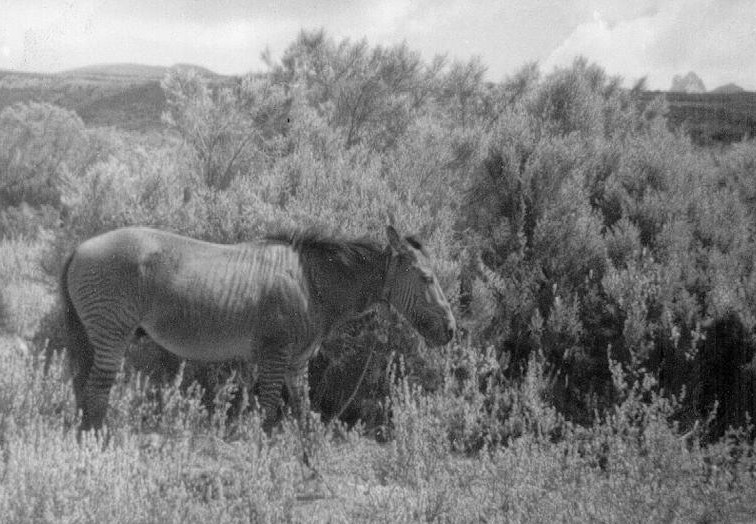
At 10,000 feet we were warm enough in our double-thickness sleeping bags, but early next morning – ugh! Washing in an icy mountain stream at daybreak was hardly my idea of fun, however invigorating. After a leisurely breakfast, we helped to load the mules and zebroids, not without some difficulty owing to the latter’s strenuous objection to obeying the call of duty. The zebroids – bred locally by an enterprising farmer using a semi-tame zebra stallion and various pony mares – were amazingly good pack animals, being tough and extremely hardy, if a trifle wild. Apparently they had, on several occasions on their journey up, been spooked by mysterious noises in the forest on either side, and because they were herded loose ahead of the ponies there was nothing to stop them galloping flat out up the track with the inevitable spillage of some of their somewhat unstable cargo of camping gear. 
Mounting our (by now) very fresh ponies, we set off, taking our time to examine the unusual plants and constantly stopping to take photographs. Soon we entered the Alpine zone with groups of the peculiar giant groundsel, looking like overgrown cabbage trees, and the beautiful silvery feathered lobelia acting as lone sentinels. At mid-day we stopped to picnic in the lovely Kazita valley, attracted by the gurgling of a cascade of delicious, cool water. We had time, while the animals grazed, to sketch or photograph the panoramic view now gradually being unfolded, but it was not until we later gained the summit of a col above the valley that the full impact of the massive range hit us. There at our feet lay the Hinde valley where we would make “Top Camp” that night. In a semi-circle above it towered Batian and Nelion, like twin turrets of a mighty fortress, surrounded by a host of lesser, but equally imposing peaks, with knife-like edges resembling battlements. Lenana (which we were to attempt next day), Point Thompson, The Pillar and the vast bulk of Sendeyo-Terreri stood like triumphant guardians. No wonder the local Masai people so revered the mountain that they had named the most impressive peaks after their chiefs.


 That evening, contentedly munching their ration of easily-transportable cubes, the animals seemed little affected by the 14,000 ft altitude, and the only concession made being the thick blanket and sacking rug which the ponies wore overnight. The mules and zebroids seemed impervious to the bitter cold. The ponies had carried us remarkably well, taking their time and picking their way through the swampy stretches with ease. Dismounting, we led them down any really steep hills, but when one of our party sprained her ankle and had to ride for the rest of that day, her pony managed the rocky slopes with gay nonchalance

Hyrax screeched incessantly from their citadels higher up the hillside, challenging this intrusion into their private territory. As if to make amends for that breach of etiquette, our first visitors were the ultra-friendly hill chats – perky little brown fellows who lost no time in welcoming us with open wings, as it were, and certainly with open beaks. Hopping to and fro, perching on the food boxes, they would disappear inside them to inspect our stores. Hungrily they accepted any tasty morsel of bread, cake or biscuit before retiring to their snug nests in old, decaying stems of the lobelias. At dusk the clockwork rats intermittently began to visit us, wearing their thick brown coats and looking like animated pom-poms so round and fluffy were their bodies. They, too, fully appreciated the temporary windfall, and after making quite certain that there was not a single edible crumb left, they trundled off into the night to their perpetual quest for food. As we huddled round the fire watching the the sun sink reluctantly behind the buttress above, the silver-white of the snow shone clearly against the stark blackness of the encircling rock, providing an air of magic, of mysticism. Surely this must be an altar of the Gods.


Waking early next morning we found the mossy turf frozen with rime, which crackled under our feet. To get water for cooking we had to break a thin film of ice on the little stream nearby. Soon we were on our way towards the most difficult and exciting part of our journey – the ascent of Lenana, the third highest peak (Batian and Nelion being unassailable for mere amateurs such as ourselves). Now we mounted the mules which were stronger and more sure-footed than the ponies. My mule, Margharita, seemed to think nothing of carrying me up the seemingly vertical slopes of loose shale, and each time we stopped for a breather it was as much for my sake as hers. The thin air at this altitude precluded any un-necessary expenditure of energy. The going was rough but we made slow, steady progress on and on, higher and higher, with each rise bringing us a little nearer to the summit.

The first snow slope gave us a few moments of anxiety as the mules plunged in up to their hocks, but when we dismounted we found that they were quite capable of making their own way, while we struggled behind. But at last even they could go no further. We had reached the foot of Lenana. So, after a short rest, they were escorted back down to the camp to await our return. They had more than proved their worth and we had nothing but the greatest praise and admiration for the way in which they had tackled a very tough assignment. Their display of courage and sheer “guts” was an inspiration to us all.


From then on we were under our own steam, and that was where our crampons and ice-axes came into their own. The first half mile was a relatively easy scramble along the top of a ridge and around two unbelievably-emerald tarns, but our experienced guide then insisted on roping us up together as the snow was dangerously soft, and to circumvent the concave wall to our left we would have to belay. All this was new territory for the three of us apprehensive novices. In the shadow of the rock it was freezing, and our fingers became so numb that to handle the rope was agony. Then halfway round – horror of horrors – everything seemed to be swimming in front of me. I blinked hard and shook my head, but soon realised that it was no good. One of my dreaded migraines was upon me. How I ever managed to reach the end of that wall I shall never know. I remember only an intense longing to stop, curl up and go to sleep then and there.
At last we did stop for a compulsory long rest to allow my vision to return to normal, then with the worst over, we tackled the last snow incline, and we were there – 16,355 ft above the world. An electric thrill of achievement surged through us as we realised that at last we had indeed reached our goal. Although it was not our highest record, we had all (including my fellow female companion who had been born with a hole in the heart) climbed Mt Kilimanjaro, it was one of the toughest and certainly the most rewarding experience of our lives. We felt that we had truly reached the Mecca of Meccas – the very summit of existence.


Thursday, 4 October 2012

Success or failure?

A few things recently have got me thinking about the definition of success, in particular, some discussions today with various Exodus staff about the trip and their perception of my ability (which, I have to say, is rather different from mine, but then they don't actually know me). To cut a long story short, they told me their main aim is "to get me to the top safely". Now that's all very well, and of course I want to get to the top safely, but is that actually my primary aim? Will I consider that a success and anything else a failure? Sounds obvious, but I'm not so sure. If it were easy, I wouldn't be doing it in the first place. What if someone were to help me? How much help would I theoretically allow while still constituting it a success? If it's not tough, there's no point in it.

Someone I know via a facebook group, though never met, and who has type 1 diabetes, attempted to climb Kili last month with Jagged Globe. She only made it to day 2 before she was hit with a stomach bug and was taken back down. I know just what D&V while trekking up a mountain feels like, from my Inca Trail experience, and it's pretty nasty, though I managed to complete my trip (mainly because there actually wasn't a possibility of going back). That I would definitely consider a failure, though of course, it was not her fault, just unfortunate. And it is in fact my biggest fear.

Jerry Gore (pictured right on the North Face of the Eiger), another online friend with type 1 diabetes, and a serious climber, recently attempted an incredible challenge to raise money for young Nepalese people with diabetes, by climbing three of the Alps' toughest routes: Divine Providence, Chant du Cygne on the North Face of the Eiger, and the Fish on the South Face of the Marmolada. You can read about his exploits here. He completed 3 climbs, but two of them were on different routes because of various problems, and he felt utterly disappointed with the result.

In his words: "By midnight I was back at the car. The other two climbers had driven off to a warm hotel (lucky Germanic bar stewards!) and I was alone in the forest, cold but okay, waiting for Calum. I tested; 170ml/dl. High but not too bad after what I had just been through – almost 24 hours of non-stop action. I took a couple of units of fast acting insulin. I began to reflect on what we had just done and what I had achieved this summer and simply broke down – the tears cascading down my cheeks. Climbers are never satisfied and are their own worst critics. I had failed, failed to properly complete my challenge, failed to do what I set out to do. Failure, pain, frustration. It all just hit me. My right elbow was constantly inflamed now and needed surgery. My knees were wrecked and in general I felt flat – where was the elation. Where was the adrenaline, the high, the feeling of achievement? Had I done it?" For him, partial success was not enough, even though, as he himself admitted, had achieved some incredible things despite many adverse conditions." 

He later does, however, acknowledge his own success: "I would like to end this piece by saying I finished the climb easily and in control. I achieved an amazing route and all went well. But I can’t because I didn’t. We succeeded in making the right mountaineering decision. And for that I feel proud but we only just made it and it was silver at best not gold. But one thing for sure was clear to me at that time, sitting in a dark and damp forest alone in my thoughts - it was not my diabetes that had held me back, it was not the fact that I have to manually control my blood sugars and test and inject up to 10 times a day. Bottom line – Diabetes is a real pain in the bum, it can really depress and shut you down sometimes and inhibit you but if you have the motivation and insulin and equipment it is definitely and absolutely NOT an excuse to live an unfulfilled life."

Some wise words indeed. I also wonder if achieving the goal but hating every minute of it still counts as success. I think that depends on whether you look back on it with better memories. The Inca Trail was an achievement for me, despite the one tough day of being ill, because overall it was a fantastic trip. Toubkal was an achievement in that I actually reached the top, but my memories are marred by some lesser moments and by the fact that I felt no one else cared whether I achieved my goal or not. On the last cycle trip I did (2 weeks around Cuba) I met my goal of never giving up and riding in the support van (unlike at least half the group), so that for me was a huge success. 

Ultimately, for me success boils down to whether I will look back on the trip and be proud. Jerry, while disappointed and dissatisfied, is clearly still proud of his achievement (and rightly so). My mum climbed Kili in 1962, and had a pretty tough time of it, but despite shrugging it off with a mere "it was awful, but I just got on with it, it's what you did", I know she's secretly pretty proud of her  achievement (and I am very proud of her too!). So, if I don't make the summit itself, I'll be incredibly disappointed, but I know it's not wise to focus everything on making it, in case something happens that's out of my control, such as severe altitude sickness. But I hope, like Jerry, I'll at least be able to look back with pride and think of what I've still achieved. And of course, try again another time.

Saturday, 29 September 2012

No turning back

Gulp. I have finally bitten the bullet and actually booked my Kili trip with Exodus, after I've read the trip notes at least 20 times and kept an eye on the reviews of past travellers and the availability of the trip, just in case I discover anything unexpected. But faced with an (unusual) free weekend, idly sitting at my computer pretending to work but looking for distraction, I decided to have just one more look at the website and found myself making the booking. My biggest dilemma was whether to pay the extra £200 to have a room and tent to myself. I've done it both ways in the past. I usually book a single room/tent but on my last trip, I ended up having to share a tent after the first night due to another person's tent breaking and them not having any repair kit or spare tents. I'm always a bit nervous of sharing especially as I don't sleep very well, which means  I wake up the other person moving around and getting up in the night, and/or I get annoyed because they wake me up doing the same thing. In Morocco, however, I couldn't have asked for a better tent partner. She never stirred during the night (while I was up at least once if not several times) and she wore earplugs so wasn't at all disturbed by me.  It was also rather reassuring to have someone else there with me in the rather scary howling winds which kept us awake - not just because of the noise but because of the very real danger that the tent would break or collapse (the main dining tent did exactly that on several occasions). Since we also had to erect and dismantle our own tents every day, it was a definite bonus to have someone to share that task with. But on reflection, and since we don't have to erect or dismantle our tents on Kili, I opted for the luxury of being able to sleep the way I want, move around as much as I want in the night, and arrange my kit with plenty of space without having to worry about anyone else. On top of £2,000, an extra £200 isn't that much, and I figure since this is going to be a pretty tough trip, I might as well go for a few little luxuries such as being able to sleep without someone snoring down my left ear or emitting noxious gases.

Friday, 28 September 2012

The beauty of going on a trip with strangers

After my experiences in Peru with altitude and dehydration, and on the advice of some seasoned Kilimanjaro guides, I decided to try out another high altitude (above 3000m) trek before embarking on Kili. I recently got the all-clear from my medical team to tackle Kili so this was the last hurdle to overcome before booking the trip. When I mentioned this to someone recently, they were stunned - not that I got the all-clear, but that I have a whole medical team to look after me, not just a GP! In case you're interested, I have a GP, a diabetes consultant, a retinal specialist, and a pump-trained DSN, all of whom I see regularly, and should I require it, I also have a chiropodist, dietician and psychiatrist at my disposal - that's one good thing about having a serious medical condition, there are specialists hovering around your every move! Anyway, I digress. Finding a week free in my busy schedule, and wanting somewhere fairly cheap and not too far away, I decided on Mt Toubkal in Morocco. The trip involved a week in the Atlas Mountains, with the ascent of Toubkal (4216m) as the toughest part. Apparently it's ranked #280 of 953 things to do in Morocco by Lonely Planet travellers, though I can't imagine 279 things to do in Morocco that would be more fun. 


The trek was classified by Exodus as a C grade trip, so I knew it would be tougher than the previous treks I've done with them, which had all been classified as B, although the most recent one was definitely (even according to the guide) more like a C grade, with long days in the mountains and a lot of ascent. This time my fears were slightly different from those on the Inca Trail. The camping aspect didn't bother me at all, in fact I was looking forward to that above all else, and perhaps surprisingly, the altitude wasn't a major concern as I figured I now knew how to deal with it after my Peruvian experience. All I needed to do was drink lots (of water) and then drink some more, and try not to think about the horrors of having to get out of the tent in the freezing cold at night and wander around in the dark on top of a precarious cliff edge to pee. I thought if I could avoid getting ill, everything would be fine. However, as I monitored the weather forecast in the preceding days, and saw the thermometer sitting at a toasty 45 degrees in Marrakech (an extra 10 degrees hotter than usual for this time of year) I realised that the heat could actually be my biggest problem. How was I going to keep my insulin cool on trek? And what would happen if I couldn't? All my spare insulin would be equally hot - and ruined. Because our kitbags were being transported by mule this time, there was also the danger that something would happen to my medical supplies. What if a mule were to fall off the mountain or decide to escape? I also suspected that the muleteers would throw my bag around even more violently than the Royal Mail, so everything needed to be bomb-proof if my medical supplies were to remain intact. More about those aspects in a separate post about managing diabetes in hot weather on a mountain, but in summary, I managed what I consider to be excellent diabetes control under the circumstances (actually way better than I often get at home!).

It turned out that fitness was actually my biggest problem on the trek. Apparently we had an unusually fit group, and it was rather disconcerting to be the slowest person on the tough days, not just uphill but sometimes downhill too! I soon realised that I needed to go at my own pace, even if it meant holding up the others, but it made me feel terribly guilty to do so. On the day we summitted Toubkal (more about that in another post) I was devastated when we finally got back to base camp at the thought that I had been slowing everyone down and they were annoyed at me. I was assured by a couple of people later that this wasn't the case, and that they were just concerned if I was OK, but I'm still not so sure. One thing though, I was definitely feeling the effects of dehydration and altitude (which oddly no one else seemed to be) despite making a conscious effort to drink a lot. Another lesson learnt. What I think is a lot of water is not nearly enough. And going to the loo in the freezing cold on the edge of a mountain in the pitch black at night with mules wandering around - no matter how many times - is still better than feeling ill from ascending a mountain when dehydrated. Even though it never feels like it at the time. 

Despite the fact that summiting Toubkal was the toughest thing I think I have ever done, I'm glad I did it as it made me realise that I have some hard work to do before February, but at the same time these things are achievable if you have the right attitude. I never doubted for a minute that I would get to the top of Toubkal, no matter how long it took and how annoyed with me everyone else was for being slow. I know this is the most important thing I'll need when climbing Kili - that determination to succeed no matter how much pain it involves. I did this trip and I'll do Kili, not to make friends and have a good time, but for myself and for the greater good of JDRF. In addition, I learnt a lot, both about myself and about trekking up mountains, and have some wonderful memories. The thing I find hardest is remembering this and trying not to spend so much time and effort worrying about what other people think. Even if everyone hates me afterwards, well that's the beauty of going on a trip like this with strangers - they never have to speak to me again if they have got fed up with me. I still hope they like me though.


Diabetes on a mountain

One of the biggest worries about my trek in Morocco was the heat (a toasty 45 degrees in Marrakech, though progressively cooler as we got higher). How was I going to keep my insulin cool on trek? And what would happen if I couldn't? All my spare insulin would be equally hot - and ruined. Because our kitbags were being transported by mule this time, there was also the danger that something would happen to my medical supplies. What if a mule were to fall off the mountain or decide to escape? I also suspected that the muleteers would throw my bag around even more violently than the Royal Mail, so everything needed to be bomb-proof if my medical supplies were to remain intact.


I decided to pack all my insulin in a Frio bag, except it turned out that the Frio bag I have is actually designed for an insulin pump (a rep gave it to me about 15 years ago, and I've never used it) so not really designed to fit several vials of insulin. Removing the packaging meant I could fit one vial and some cartridges in the pouch, the other vial I had to just hope for the best. The beauty of a Frio bag is that it's activated by cold water so I could reactivate it mid-trek if necessary. I then put this in a Ziplock bag, wrapped it in a spare buff, and wrapped that in my waterproof jacket which lived at the bottom of my daysack all week on trek. The rest of my medical kit I packed (well-wrapped) in the middle of my kitbag wedged in between clothes, and crossed my fingers. You have to live life a little dangerously on these trips or you'd never get anywhere. 

As for the pump itself, I used a SpiBelt (see pictures) to attach it around my waist under my tshirts (as I usually do) and hoped it would stay cool enough. These precautions turned out to do the trick perfectly. I also packed a spare blood glucose meter and strips in my kitbag (after reading Jerry Gore's story about his meter packing up while climbing in the Alps), although - like Jerry - I only had a handful of strips that fitted that meter, so I was trusting to luck again that I wouldn't need it from day 1! Based on previous experience, I reduced my basal insulin on the trek to approximately 50% during the walking itself, starting an hour before we set off in the morning and finishing, where possible, an hour before we finished. I then set it to 70% for the night and 80% for the rest of the daytime when not walking. This strategy - with a bit of fine tuning along the way - worked incredibly well and I had the best blood sugar levels of any trip I've done! I only needed to adapt a little when there were long downhill sections (where I didn't use so much energy), and kept the Haribo handy in my waistbelt pocket for regular small topups on the climbs. Luckily, we had an identical breakfast of (pretty horrible) porridge every morning, for which I bolused my usual amount but over an hour instead of all at once, and again this worked perfectly. For lunch I reduced the bolus by 50% but without the square wave, and this also worked well.


The fact that most of the meals were relatively low in carb with lots of vegetables (mainly carrots), and were quite consistent (some would say boring) actually helped a lot and I had pretty good control throughout with no major lows or highs until, oddly, the day after the trek ended when I had some terrible lows! Figuring out how to gradually raise the basal back to normal seems to be a black art - for the first few days you're obviously expending less energy but your body still burns a lot of fuel until it gradually begins to realise it doesn't need to. Something to be wary of next time. But all in all, a great success diabetes-wise, which was actually my biggest fear. Fitness-wise, another story....I definitely need to step up the training before Kili! 


Sunday, 12 August 2012

Wings of Kilimanjaro


As if climbing Kili wasn't bad enough, imagine doing it with a full paragliding kit on your back too. That's what 200 other people will be doing in early 2013. According to http://www.wingsofkilimanjaro.com, a group of adventurers from every corner of the globe will come together for a once-in-a-lifetime, world record-breaking event to climb and fly from the “Roof of Africa” - Mt Kilimanjaro, the highest free-standing mountain on the planet, and in doing so will raise over a million for charity. Makes my attempt just to climb it seem a bit puny in comparison.

Squash Falconer (how I love that name!) has just come back from a reconnaissance trip for this event, which she's  blogged about. Sounds like an immense coordination effort, but what a spectacle it will be! Idly browsing their website, I stumbled on the dates for their proposed attempt, and discovered that they aim to do it on Feb 5th, although there's a window of about a week, depending on conditions. Coincidentally, not only is that my birthday, but it's the exact week I'll be climbing Kili. So with any luck I'll not only see them make their flight, but maybe even get to climb with some of them or share base camp with them. I actually held a club paragliding license nearly 20 years ago, but haven't renewed it since. Not sure that blind people would be allowed to paraglide these days anyway. Or at least, not solo. I think I'll stick to just climbing Kili for now.