Monday, 31 December 2012

Mountain kit

Although I've done a few mountain treks in the last few years, it soon became obvious that a lot of my tried and tested kit is not quite up to scratch for the severe cold I'll be experiencing on the last couple of days on Kili, or just because some of muy kit is old and knackered. So I've been forced to upgrade a lot of it - an expensive business, but worth it as the last thing you want is to fail due to kit. I've also been desperately reading up on what the most suitable things are. I'm hopeless at making decisions at the best of times, especially shopping decisions, so this has proved a mammoth task for me, and I've been trying to get lots of advice about what to take.

Here are the major items I'll be taking.

4 season sleeping bag - planning to get an Alpkit Pipedream 800, but they're currently out of stock and don't know when in the new year they'll have some in, so this is causing me endless dilemma. My second choice (more expensive, but just as good) is a Rab Ascent 900. Update: I bit the bullet this week and bought the Rab Ascent 900.

I have a brilliant silk liner which I always use inside a sleeping bag - both for extra warmth and so my main sleeping bag doesn't get dirty.

My amazing Ajungilak air pillow Squishes down to nothing when deflated and it's by far the most comfortable travel pillow I've tried. I've never found stuffing clothes in a bag in any way makes a comfortable pillow. It's got a fleece outer, so it's nice and warm, and not slimy like most inflatable pillows. And as the review says, "unlike other travel pillows, it won't fart in the middle of the night".

Womens ProLite Regular 3 self-inflating mat. Finally replaced my old one I'd had for more than 10 years, as it was starting to leak a little.  And the pink one is obviously way better.

Rab Womens Vidda waterproof jacket Brand new, finally replacing my very old but much loved Craghoppers waterproof. Should be able to withstand pretty much anything the heavens will throw at me. Tested it out in the Peaks a few times, and so far so good.

Womens Rab Neutrino Endurance down jacket. First time I'll have tried this out, but it seems very warm!

My trusty Decathlon winter trousers (they're actually ski trousers, but I wear them for all winter walking and outdoor activities. Warm, flexible, snowproof and bombproof. Something like these.

My old Decathlon thermal leggings.Cheap and cheerful, but they're warm.

 UnderArmour Womens ColdGear fitted crew thermal top. Bought these for softball, but I wear them all winter for walking. Super warm and they wick sweat really well. Really important when you're walking in the cold, otherwise you freeze as soon as you stop.I'd wear an Icebreaker thermal top, but I'm allergic to wool.

An amazing BlackYak thermal zip top I bought in a market in a market in South Korea 6 years ago. Never seen these anywhere else. By far the warmest and best thermal top I own, wearable either as a base layer or on top of an existing one. I wish I could find more of these.

Old trusty Mountain Equipment fleece jacket, something like this Qupik one.

Smartwool trekking socks - I've recently become a convert to these. I can't wear merino on my body, but it seems OK on my feet and hands. (unlike normal wool). These are wonderful - warm in winter but cool when it gets hot. In winter I wear Bridgedale liner socks underneath for extra warmth.

My old trusty convertible walking trousers, bought in Germany years ago. Lightweight, quick drying, lots of pockets, and they zip off into shorts. Brilliant. And unlike most of the ones you get in this country, they're not ridiculously tight around the thighs. Why this is only the case for convertible trousers, but not for normal walking trousers or shorts, I have no idea. But it is fact.

Old trusty  Decathlon 32 litre rucsack. Similar to this one. A little heavy, but the back system is brilliant, comfortable and not too sweaty. It has lots of pockets, an integral rain cover, well padded hip belt and shoulder straps, walking pole storage, and very useful pockets on the hip belt.The water bottle holders aren't great, but I tend to use a hydration system anyway, so no problem.

Brand new Gordini ski mittens. Bright pink so I don't lose them. With these Smartwool liner gloves  underneath.

Fleece balaclava, bought in the US. Tried it out on a ridiculously windy ascent of Mam Tor last week, and it did the job. The wind was strong enough to blow me over, but my face stayed warm. I'll supplement this with a couple of multi-purpose buffs.

Barts woolly hat.

A couple of sleeveless technical tops for the warm days. I especially like my UnderArmour HeatGear ones.

And finally, some new Scarpa Mistral walking boots which I have yet to break in....(not the smartest idea to get them this late, but that's another story).


Sunday, 30 December 2012

A month to go!

I just realised that in exactly a month, I shall be taking the plane to Tanzania and the start of the trip of my life. Time to start fine-tuning and double-checking my kit, and to try to get in some more hill walking, not made easier by the horrendous rain we've been having over Christmas and the huge work deadline I have on 15th January, which has been consuming literally all my time over the Christmas "holiday". Despite my best intentions, I had a whole week with no exercise apart from the odd 30 minute walk with my mum and her dog (on the flat) over Christmas, and after my first circuits class back after just a week off, my quads and hamstrings are screaming at me today. Hmm, clearly not as fit as I thought then. I'm also starting to worry about kit - the sleeping bag I was hoping to get from Alpkit is still out of stock and not going to be ready in time, so I think I'm going to have to spend an extra £50 and get a Rab one (which is also about 500g heavier). I just can't quite make the decision.

And I'm still umming and ahhing about walking boots. My lighter ones I bought for summer didn't stand up well to the snow in the Peak District the other day (my feet felt very cold) and having tried again my old Meindls (heavier, toasty warm, but sometimes give me blisters and also have no grip left)  I decided they really don't cut the mustard. So I bought a pair of Scarpas (having seen them in Blacks for £120, then found them in TK Maxx for £70) and am now wondering how they'll fare, as I don't have much time to test them and break them in. I'm wearing them round the house and trying to decide whether to keep them (and test them properly outside). There are probably half a dozen minor things I still need, like figuring out a way of using my hydration system so it doesn't freeze in sub zero temps (because if I use an insulated bottle instead, I know I'll never get it out of the bag and actually drink from it). And debating whether my rucksack is going to be adequate (it's 30 litres, so a little on the small side, and although comfortable and with loads of useful features, is actually quite heavy). I also need to get a prescription for Diamox from my GP, and see if I can get him to prescribe me the TruOne meter/strips combo thing as a backup for my blood glucose meter. I've also been experimenting with a different meter after my trusty Ascensia Breeze 2 broke (they don't make them any more), and am weighing up the pros and cons of a meter with integral strips but which is heavier and bulkier, with one that isn't integral and involves faffing with a pot of strips). So far I think the ease of testing outweighs the bulkiness issue.

I also need to step up the fundraising drive, something I hate doing, but very few people have actually sponsored me so far. The university staff newsletter were very keen to do a story on my trip, so I'm hoping if that goes ahead I might get a few more sponsors.

So a busy time ahead. I've been compiling a post about all the various pieces of kit I'm taking, but still have to finish that one....should be coming soon.

Saturday, 8 December 2012

How will I know when I'm fit enough?

So the fitness training continues, and I'm getting quite nervous now I've realised that in precisely 8 weeks' time, I shall (with any luck) be standing on top of Africa. Training has been severely hampered by the fact that I've spent most of the last 6 weeks travelling for work (ever tried getting fit while on a 10 hour flight?) and while I've been away my days have been jampacked with work and the necessary socialising that accompanies it. No point travelling all the way to the USA if you then don't have time to chat with the people you've come to see, because you're too busy getting fit. In Boston, I did manage to go running most days first thing in the morning, which was beautiful along the river, and more importantly, flat. Which did wonders for my confidence. And in San Francisco, I spent an afternoon cycling around the (very hilly) city and across the Golden Gate Bridge.

I also managed to break my finger playing korfball last month. It was a pretty bad break and for a while the doctors debated whether an operation was needed to pin it back together, but luckily it started healing straight and I avoided that. For the first couple of weeks, even running hurt (yes really!) due to the jarring motion. And I certainly couldn't lift weights. A month on, and it's better, but I still can't use it and have to avoid bumping it or putting any weight on it, which means no korfball and limited activities in circuits classes.

While I was in Boston, a friend came running with me, and she asked how I would know when I was fit enough. My answer was that I have absolutely no idea. Which got me thinking about the nature of my training, and I started asking various people for advice. Of course, the more people you ask, the more different answers you get, but most people seemed to think I was doing the right thing by mixing up different kinds of fitness. And most people seem to think I'm fit enough already, but I know I'll never be fit enough....that's what comes of being a perfectionist. I'll feel happier when I've got a few more proper hillwalks under my belt. Sadly I'm so busy with work at weekends it's hard to find the time, and my usual walking companions also haven't been available. But we have been out in the Peaks about once a month at least. Here's me practising my rock climbing on Kinder....and the view from near Alport Castles.


But we're hoping to get in a trip up Snowdon in early January, which will also be a test of wintry conditions. This is when I wish I had a 9-5 job where I didn't have the constant pressure of having to work weekends and evenings, and could dedicate these to fitness and get out in the hills more. But such is life. It's a tricky balance between work, sleep and fitness right now, not to mention trying to have a social life. But I'll know when I get really nervous about Kili, as I'll start waking up at 4am worrying about that instead of work.....

Friday, 19 October 2012

Training

People keep asking me about my training for Kili, so I thought it was time to document it. Always a big motivator. I'm not doing much more exercise than I normally do in winter (though oddly it's more than I do in summer), but I'm trying to step up the intensity a bit. My average week consists of:

Monday - 90 minutes of korfball (a bit like a cross between netball and basketball, which involves a lot of running around!)

Tuesday - an hour of Body Max class (like Body Pump - basically free weights, pressups, squats, stomach crunches, dips etc etc). I'm trying to increase the weights and intensity, though I'm struggling with shoulder issues and a dodgy knee at he moment.

Wednesday - 45 mins spin class. Again, trying to push myself more than usual.

Thursday - an hour's Body Max class at lunchtime and an hour's spin class in the evening.

Friday - 45 min spin class.

Saturday - an hour's circuits class, again pushing myself more than usual. Or a 5-7 hour walk in the Peaks with friends.

Sunday - 30 min abs class followed by an hour's Body Max class, or a 5-7 hour walk in the Peaks.

I also walk 25 mins each way to work and back every weekday.  The way back is up a very steep hill most of the way, so I'm trying to push myself up that too and basically speed walk up it, usually with a rucksack full of gym kit, books etc.

I feel this isn't really enough, so I'm trying to figure out how to fit in some running. Which I hate, but Sheffield is full of hills, so it's good practice. Maybe at the weekend, since I can't face getting up early, and anyway it's still dark in the mornings when I get up. My main problem is keeping up with fitness when I'm away, as I'm travelling a lot for work at the moment, and it's hard to find the time when I'm away. Especially as I can't run in the dark due to my sight issues. I'll be very happy to hear your suggestions for ramping up the fitness.

I'm also trying to get in a couple of longer walks. I'm planning a trip up Snowdon with some friends sometime in the next few weeks - oddly I've never actually done any of the routes before. Really excited about that!

Tuesday, 16 October 2012

If my mum could climb it 50 years ago....

So my mum climbed Kilimanjaro 50 years ago, when there was only one route, she had never even seen snow before, and they had nothing like the equipment we have now. A certain nameless person read the blog post about her trip and said "I can't see how that could possibly inspire you to climb it. But good luck." I beg to differ. The fact that they succeeded back then makes me all the more determined to succeed now. If they could do it then, I certainly can now!

Over 20 years ago, I did a bungy jump off Kawaru Bridge in New Zealand. I hadn't intended to do it at all. I'd heard about bungy jumping and thought that while it sounded incredible, it was a totally ridiculous idea and I'd never be brave enough to do it. After all, I'm not particularly fond of heights. But I was travelling with a group of people, some of whom planned to do it, and I heard that if you were over 70, you could do it for free. And what's more, quite a few 70 year olds, and even an 80-year old, had done it. Well, I thought, if they can do it at that age, what possible excuse can I have when I'm only 19 and fit and healthy? So I did it. And yes it was the most terrifying thing I've ever done in my life. I thought I was going to die as I hurtled through the air. And I tore all my stomach muscles bouncing around on the rope after I hit the river. I could barely walk for a week. Would I do another one? Probably not, I have nothing more to prove. Am I glad I did it? Absolutely. But I digress....


The post about my mum's trip got me thinking about the differences between then and now. The toughest thing about climbing Kili, without a shadow of a doubt, is the altitude. My mum and her friends lived in Molo, Kenya at an altitude of 2,500m, so this was an enormous help. And indeed, despite the quick ascent, none of them appeared to suffer from any kind of altitude sickness, which seems to be pretty rare. On the other hand, they weren't experienced at climbing mountains, they had never experienced anything like such cold (my mum owned the grand total of 2 woolly jumpers, both of which she was wearing for the climb) and they certainly didn't have merino baselayers, wicking tops, fleeces, proper waterproofs, down jackets,  ski gloves, 4 season sleeping bags, Smartwool socks or anything else, just cotton shirts, woolly jumpers and socks, a rubber non-breathable jacket, and a borrowed balaclava, woolly gloves, and borrowed boots which were something like a cross between wellies and riding boots. They also didn't have proper rucksacks, blister plasters, head torches, hydration bladders, muesli bars, mobile phones, or a myriad of other things which I plan to take! I'm not entirely sure what they ate, but I doubt it was particularly appetising. At times I wonder how on earth they managed without all these things. But even now the porters have very few of these things, though they do have slightly better clothes, sleeping bags and food at least. In 50 years' time I expect my nieces and nephews will look back in amazement at the equipment we used in 2012.

On balance, while they had the advantage of altitude training, the conditions were still incredibly tough. They also didn't have the benefit of knowledge, which may have been a good or bad thing. No books on climbing Kili, no internet to look at pictures and read other people's blogs, no emails from others who had done it, no kit lists or trips to outdoor adventure shops, just a guide who assured them they'd be able to borrow whatever they needed from the hotel, and to bring some warm clothes. They actually had no idea what they were letting themselves in for. I can't even imagine attempting a trip like that without that kind of knowledge first. But then again, I'm sure my mum can't either now!


Wednesday, 10 October 2012

Climbing Kilimanjaro 50 years ago

Below is the second guest post from my mum. I'll definitely be thinking about her experience when I'm struggling up that hill with all my fancy modern gear!


CLIMBING Mt KILIMANJARO 50 YEARS AGO


As a 21st birthday celebration my mother suggested a trip to climb Mt Kilimanjaro which was hastily accepted – a happy co-incidence as Kili was supposed to have been given as a birthday present to the Kaiser Wilhelm II by his grandmother, Queen Victoria, in the late 1800s. The kink in the present Kenya/Tanzania border would tend to corroborate this story. At the time the British Government had been allocated what are now Kenya and Uganda for trading and development, which became known as British East Africa, while the land south of Kenya was given to Germany and was known as German East Africa. The latter was re-named Tanganyika after the First World War when it became part of British East Africa after the defeat of the German army.

The routine way to do this expedition was to join a group organised by Marangu Hotel in the southern foothills in Tanzania. The climb entailed a four day slog, using existing huts to sleep in at nights, one above the forest line and the second at the bottom of Kibo. In the typical laid-back style in East Africa we were just advised to bring “warm clothing and stout footwear”. Although the five of us lived in the Kenya Highlands at varying heights (my home at Molo was 9,000 ft above sea level) we had never needed the relevant clothing to cope with the cold at the extreme heights to which we were ascending. No problem they had said, you can hire anything you need at the hotel. In the event we all needed snow goggles, balaclavas, gloves and long walking sticks. We carried only our personal urgent needs in small rucksacks, the rest of our equipment being carried by porters who followed us up the mountain. My own clothing was typical of the group – a couple of thick jumpers, cotton trousers, a rubberised waterproof jacket and two pairs of thin socks, plus a pair of short leather boots borrowed from a boyfriend. When climbing Mt Kenya five years later I did at least own a pair of stout jodhpur boots! Such modern luxuries as thermal underwear and padded jackets were quite unheard of then.


This was to be a major safari for my mother and me, having to drive from our home in Molo, at the top of the western escarpment of the Rift Valley, via Nairobi to Marangu, a journey of over 300 miles mainly along very basic dirt roads. As we got to know each of the other climbers in our group that evening, we were suitably inspired by the tantalising view from the hotel of the tops of both Kibo and also the smaller, dormant, Mawenzi. Early next morning we set out on our first day's walk up through the indigenous forest along a very muddy track to Bismark Hut, nestling at the foot of a cliff amongst the trees at a healthy 9,000ft. The accommodation was pretty basic with two dormitories each having several bunk beds consisting of a wooden frame covered with a thin mattress, over which we laid our sleeping bags. An outside “long drop” was located nearby but there were no washing facilities other than a bucket of cold water! We were all more than ready to eat our frugal supper seated round a camp fire in front of the hut at sundown (which is short-lived and barely lasting 15 minutes at about 7.30 p.m.) and chat by the light of a couple of Deitz (paraffin) lamps until retiring to snuggle down into our bedding shortly afterwards.

The next day we continued up a narrow track onto the moorland with tantalising views of the jagged peaks of Mawenzi slowly revealing themselves out of the mist as we climbed upwards. The scenery up here was much more varied as we traversed the saddle between Mawenzi and Kibo, and finally arrived at Peter's Hut at 12,500 ft. While the porters were unloading our gear we walked a short way up to the top of the ridge behind the hut to catch our first proper sight of Kibo in all its glory. However it was not to be, as thick cloud covered the snowy top, but the sheer bulk of it was still an awesome and somewhat daunting sight.


At about 4 a.m. the following morning we were woken by our three guides, to be plied with steaming mugs of tea and chunks of bread with which to fortify ourselves for the coming assault. None of us had slept much due to the freezing temperature and uncomfortable beds, so we were not at our best. It was, of course, pitch dark, but it was essential to make an early start in order to reach the top in time to see the sunrise at 7 a.m. By torchlight our frozen bodies set out in single file across the plateau with the three native guides spaced out between us until we stopped for a much-needed breather and another mug of tea at the foot of Kibo itself. By this time we were beginning to show ominous signs of distress – extreme lassitude, splitting headaches and in my case completely numbed hands. The chief guide was most concerned, and after a vigorous hand massage and an additional pair of gloves managed to get the circulation going again. None of us suffered full-blown altitude sickness and continued on our way. 

 The following ascent was sheer torture! Ascending in a zigzag up the scree, 6-8 steps each zig/zag, was as much as we could do at a time, such was our lack of energy and breath. Here our walking sticks really came into their own to lean on when resting as much as for balance and help while climbing. Ever onwards and upwards, until, blessed relief, we reached the rim of the crater, at Gillman's Point, 19,043 ft above sea level. Sadly the flag pole marking the spot had blown over, but was still there to mark the spot. Obligatory photos were taken to keep as proof of our conquest. We had all been born and brought up in Kenya, so none of us had experienced snow first hand and were amazed by the beauty of the ice fields along the rim.

Celebrating our success with bars of chocolate, and mugs of tea (which the guides had nobly carried up in flasks) we slowly became aware of what we had achieved. None of us cared about not continuing along the rim up to what is now known as Uhuru Peak, 600 ft higher, especially as the weather was not going to improve, and were quite content to savour the moment looking down over the thick blanket of cloud below us, highlighted by the rosy glow of the sun, which covered the whole countryside, broken only by the highest peak of Mawenzi poking its head through. That in itself was magical. We all sensed the feeling of reverence with which the native tribes regarded both Mt Kilimanjaro and Mt Kenya as the ancestral homes of their gods.

But soon it was time to begin the descent. Easy, now that all we had to do was avoid losing balance as we slid down the loose scree in short bursts, aided by our trusty sticks. We even had the energy to bypass Peter's Hut and continued on down to Bismark for the night. What bliss to be warmer and relaxed – only now could we fully enjoy comparing our individual highlights and lowlights of the trip. Never again, we all said, but agreed that despite the trials and tribulations we wouldn't have missed it for worlds.

Sunday, 7 October 2012

A 1967 ascent of Mt Kenya


Here follows the first of several guest posts by Judy Maynard, my mum, who grew up in Kenya and climbed both Mt Kenya and Mt Kilimanjaro in the 1960s, with nothing like the kit and facilities we have today! This account of her ascent of Mt Kenya in 1967 was published in "Africana Magazine", an apparently now defunct magazine, although a new publication of the same name has been in existence since 2004. I leave her to tell the story of her trip!


It was one of those cold, crisp mornings with the Kenya sky unbelievably clear pale blue. A hard frost on the grass made a jewelled silver carpet as we motored up the escarpment from the floor of the Rift Valley; the first rays of the rapidly-awakening sun greeted us over the shoulder of THE mountain, 50 miles ahead. There it stood – the ultimate goal of our long-awaited journey – beckoning us onwards, its mighty peaks sharply etched against the ever-changing colour of the newly-painted sky.

Arriving at our rendezvous, the small village of Nanyuki at the foot of the mountain, we consigned the car to a week of rest at the friendly garage. With the rest of our party we squeezed into the waiting Land Rover which was to take us up to the base camp, towards which the ponies and pack animals were already making their way.


Our route lay along the main road to the north for a few miles, then a narrow rutted track branched off, leading us almost immediately up through thick forest. At times we were more than grateful for the wire tracks laid by the British Army for use in their training manoeuvres on the steeper gradients. Up and up, climbing steadily, the monotony of the endless forest being broken only by the occasional glade, or tiny stream. Colobus monkeys, clad in their long, thick, black and white pelts, barked at us as we passed, and bright green touracos with their flashing red wings flapped heavily across the track ahead.

Suddenly, without warning we emerged onto the open moorland and stopped for our first real view. It was magnificent. Three thousand feet below us the shimmering plain emerged from the base of the mountain and stretched out until it became lost in a heat haze. Above and behind us, the peaks were hidden by a thin veil of mist, lifting occasionally to give us tantalizing glimpses. Around us stretched a sea of tussocky grass and giant heather, broken here and there by splashes of gaily-coloured wild flowers interspersed with patches of duller, everlasting flowers. A couple of miles further on we rounded a corner to find our camp set up in the lee of a sheltering rocky outcrop. The ponies, and pack-animals were grazing hungrily in the afternoon sunshine, although the cold wind made us glad of our thick jackets. 

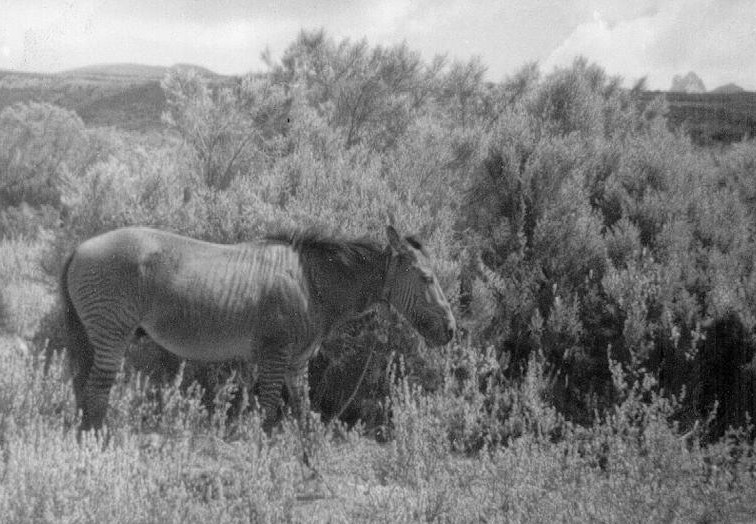
At 10,000 feet we were warm enough in our double-thickness sleeping bags, but early next morning – ugh! Washing in an icy mountain stream at daybreak was hardly my idea of fun, however invigorating. After a leisurely breakfast, we helped to load the mules and zebroids, not without some difficulty owing to the latter’s strenuous objection to obeying the call of duty. The zebroids – bred locally by an enterprising farmer using a semi-tame zebra stallion and various pony mares – were amazingly good pack animals, being tough and extremely hardy, if a trifle wild. Apparently they had, on several occasions on their journey up, been spooked by mysterious noises in the forest on either side, and because they were herded loose ahead of the ponies there was nothing to stop them galloping flat out up the track with the inevitable spillage of some of their somewhat unstable cargo of camping gear. 
Mounting our (by now) very fresh ponies, we set off, taking our time to examine the unusual plants and constantly stopping to take photographs. Soon we entered the Alpine zone with groups of the peculiar giant groundsel, looking like overgrown cabbage trees, and the beautiful silvery feathered lobelia acting as lone sentinels. At mid-day we stopped to picnic in the lovely Kazita valley, attracted by the gurgling of a cascade of delicious, cool water. We had time, while the animals grazed, to sketch or photograph the panoramic view now gradually being unfolded, but it was not until we later gained the summit of a col above the valley that the full impact of the massive range hit us. There at our feet lay the Hinde valley where we would make “Top Camp” that night. In a semi-circle above it towered Batian and Nelion, like twin turrets of a mighty fortress, surrounded by a host of lesser, but equally imposing peaks, with knife-like edges resembling battlements. Lenana (which we were to attempt next day), Point Thompson, The Pillar and the vast bulk of Sendeyo-Terreri stood like triumphant guardians. No wonder the local Masai people so revered the mountain that they had named the most impressive peaks after their chiefs.


 That evening, contentedly munching their ration of easily-transportable cubes, the animals seemed little affected by the 14,000 ft altitude, and the only concession made being the thick blanket and sacking rug which the ponies wore overnight. The mules and zebroids seemed impervious to the bitter cold. The ponies had carried us remarkably well, taking their time and picking their way through the swampy stretches with ease. Dismounting, we led them down any really steep hills, but when one of our party sprained her ankle and had to ride for the rest of that day, her pony managed the rocky slopes with gay nonchalance

Hyrax screeched incessantly from their citadels higher up the hillside, challenging this intrusion into their private territory. As if to make amends for that breach of etiquette, our first visitors were the ultra-friendly hill chats – perky little brown fellows who lost no time in welcoming us with open wings, as it were, and certainly with open beaks. Hopping to and fro, perching on the food boxes, they would disappear inside them to inspect our stores. Hungrily they accepted any tasty morsel of bread, cake or biscuit before retiring to their snug nests in old, decaying stems of the lobelias. At dusk the clockwork rats intermittently began to visit us, wearing their thick brown coats and looking like animated pom-poms so round and fluffy were their bodies. They, too, fully appreciated the temporary windfall, and after making quite certain that there was not a single edible crumb left, they trundled off into the night to their perpetual quest for food. As we huddled round the fire watching the the sun sink reluctantly behind the buttress above, the silver-white of the snow shone clearly against the stark blackness of the encircling rock, providing an air of magic, of mysticism. Surely this must be an altar of the Gods.


Waking early next morning we found the mossy turf frozen with rime, which crackled under our feet. To get water for cooking we had to break a thin film of ice on the little stream nearby. Soon we were on our way towards the most difficult and exciting part of our journey – the ascent of Lenana, the third highest peak (Batian and Nelion being unassailable for mere amateurs such as ourselves). Now we mounted the mules which were stronger and more sure-footed than the ponies. My mule, Margharita, seemed to think nothing of carrying me up the seemingly vertical slopes of loose shale, and each time we stopped for a breather it was as much for my sake as hers. The thin air at this altitude precluded any un-necessary expenditure of energy. The going was rough but we made slow, steady progress on and on, higher and higher, with each rise bringing us a little nearer to the summit.

The first snow slope gave us a few moments of anxiety as the mules plunged in up to their hocks, but when we dismounted we found that they were quite capable of making their own way, while we struggled behind. But at last even they could go no further. We had reached the foot of Lenana. So, after a short rest, they were escorted back down to the camp to await our return. They had more than proved their worth and we had nothing but the greatest praise and admiration for the way in which they had tackled a very tough assignment. Their display of courage and sheer “guts” was an inspiration to us all.


From then on we were under our own steam, and that was where our crampons and ice-axes came into their own. The first half mile was a relatively easy scramble along the top of a ridge and around two unbelievably-emerald tarns, but our experienced guide then insisted on roping us up together as the snow was dangerously soft, and to circumvent the concave wall to our left we would have to belay. All this was new territory for the three of us apprehensive novices. In the shadow of the rock it was freezing, and our fingers became so numb that to handle the rope was agony. Then halfway round – horror of horrors – everything seemed to be swimming in front of me. I blinked hard and shook my head, but soon realised that it was no good. One of my dreaded migraines was upon me. How I ever managed to reach the end of that wall I shall never know. I remember only an intense longing to stop, curl up and go to sleep then and there.
At last we did stop for a compulsory long rest to allow my vision to return to normal, then with the worst over, we tackled the last snow incline, and we were there – 16,355 ft above the world. An electric thrill of achievement surged through us as we realised that at last we had indeed reached our goal. Although it was not our highest record, we had all (including my fellow female companion who had been born with a hole in the heart) climbed Mt Kilimanjaro, it was one of the toughest and certainly the most rewarding experience of our lives. We felt that we had truly reached the Mecca of Meccas – the very summit of existence.